.png)
When you buy Palo Santo in an ordinary shop, you probably know nothing about who gathered it, where exactly it grew, or how much of the final price actually reached the people whose work stands behind it. That's not a reproach — it's simply the reality of most global trade. At Rocío, we decided to take a different path.
How does it usually work?
The typical journey of Palo Santo from the dry tropical forest to the customer's hands looks roughly like this: the gatherer sells the wood to a local buyer, the buyer to an exporter, the exporter to an importer, and the importer to a retailer. Quite a long journey for a small stick. Each of these middlemen takes their cut. At the end of the chain the customer pays a more or less premium price, but the person who gathered the wood in the forest receives only a tiny fraction. And the origin? It gets lost somewhere on the way to your living room.
Brands and companies keep appearing on the market that print terms like "ethical origin", "fair trade", or "community support" on their packaging, yet real proof and a verifiable relationship with specific people is often missing. There are many certifications, such as Fair Trade, which are a very valuable tool for those who genuinely hold them and honour their conditions. The problem arises when these labels are used as a hollow marketing device with no real substance. We chose a different path — a direct relationship. Not because certifications are bad (and for a young company they're also very costly), but because direct trade with communities gives us something no certificate can replace: specific people on the other side of the world, and the responsibility that comes with it.
The usual journey of Palo Santo runs through a gatherer, a buyer, an exporter, and an importer before reaching a retailer. At Rocío, only two parties stand between the forest and you — the community and us.
How does it work at Rocío?
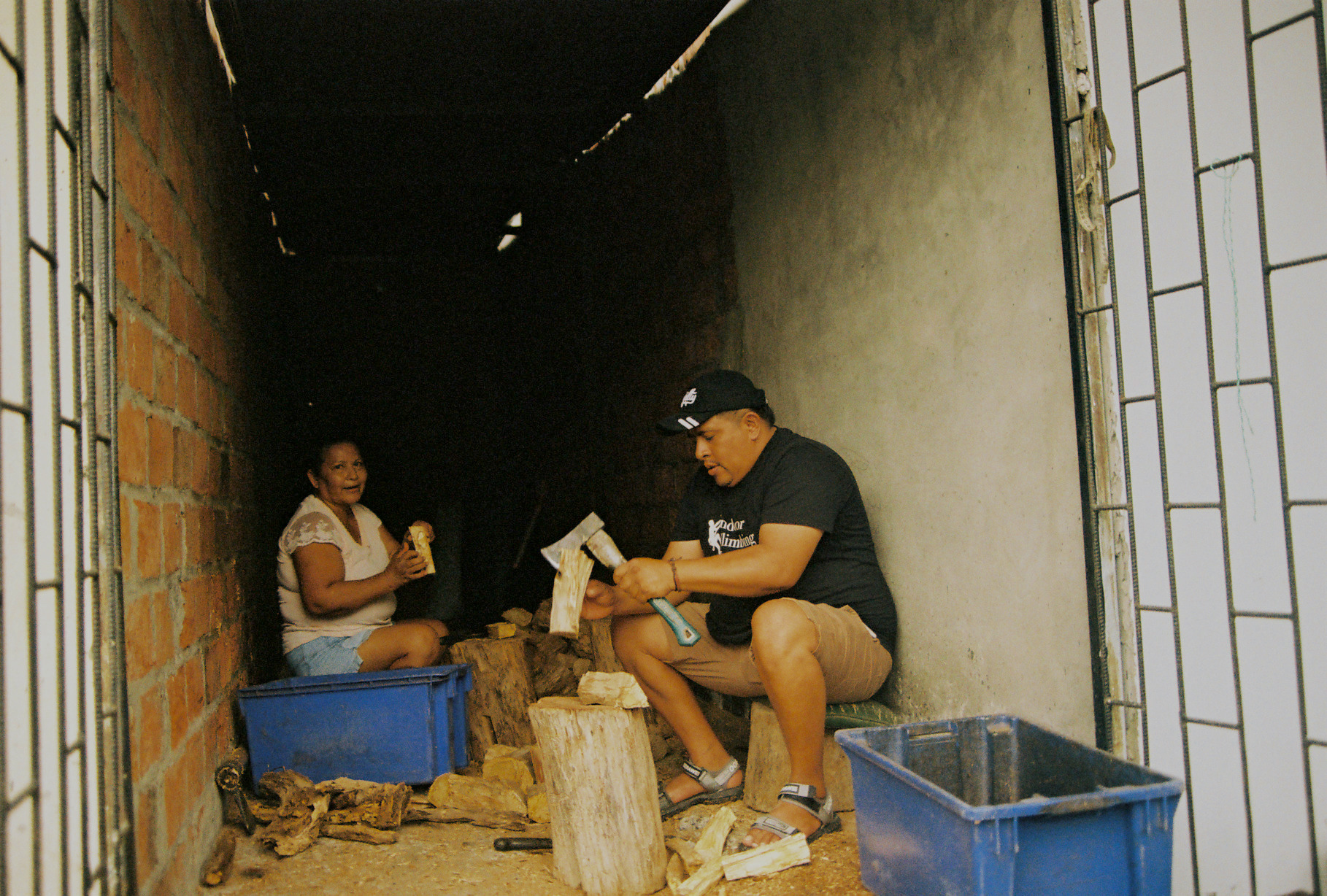
Rocío works on the principle of direct trade. Between the community in the Manabí region and you as the customer, there is no one else. When you place an order in our shop, your Palo Santo passes through just two pairs of hands — the community in Manabí, which gathers and processes it and distils the essential oil, and us, who import it to the Czech Republic. No buyer, no exporter, simply no one standing between us. We stay in regular contact with the community and visit them often. We care about long-term relationships and about the prosperity of the people and the place Palo Santo comes from.
Behind this relationship stands a specific person. Señora Rocío, after whom the brand is named, oversees every step from gathering to processing. The brand name is therefore not just an abstract claim on our packaging — it's the name of a woman we know personally, stay in regular contact with, and with whom, during our visits, we discuss both realistic and less realistic plans for the future. The collaboration began back in 2022, as part of research for a university master's thesis. At the time, probably no one believed that a naive student project could grow into a genuinely valuable and sustainable partnership for both sides. But that's the story in brief, and we'll surely return to it in more detail.
"Between the community in the Manabí region and you as the customer, there is no one else."
Our collaboration with the community in Manabí began back in 2022 — originally as part of research for a university thesis.
Why did we decide to take this path?
From the very beginning we knew one thing — we want to know where our Palo Santo comes from. Not just which country, but which specific region, which village, who the people behind it are, under what conditions everything is made, what the place looks like, what it means in the local culture, and why Palo Santo has become so popular in Europe. In short, it was relentless curiosity — and also a desire to show that business can be done a little differently. We want to be able to answer every customer question about Palo Santo, and that simply isn't possible if you don't know what you're buying yourself. Of course, doubts occasionally surface about whether this is the right path, but the feedback and curiosity of our customers — and even of passers-by — reassure us that it was the right choice.
We believe that behind every good product there are specific people and a specific place, and that this connection is worth preserving, even when it's harder and slower. It's a decision that makes sense to us in many ways: clear origin, a direct relationship, and — not least — the chance to have a positive impact on people's lives without casting them as poor souls in need of your help.
What does it bring the customer?
Direct trade gives the customer something that's very hard to quantify: a good feeling about the purchase. You know your money goes exactly where it should. You know the product you receive has a clear origin, a specific story, and specific faces. That's certainly not a given, and it's worth mentioning.
Conscious buying is rare these days, but it's definitely on the rise. Most consumption happens fast, anonymously, and without thinking about what's going on behind the scenes. Not because people don't care, but often because the answers simply aren't available. At Rocío, they are. If anything interests you — how the gathering works, how the community is doing, or how best to use Palo Santo — just ask. Write to us and we'll do our best to answer. Direct trade isn't built only on a direct path for the product, but also on direct communication with customers.
What does it bring the community?
Your support has a significant impact on the community in Manabí — and it's not only about money, even though money plays an important role. Without middlemen in the supply chain, a larger share of the price stays with those who actually work with Palo Santo. But perhaps a more important part of this collaboration than the money itself is stability. The community knows it has a long-term partner, not just a one-off buyer who disappears the moment they find a cheaper source. This relationship lets them plan ahead, invest in their work, and pass the craft on to future generations. The fact that every order at Rocío has a direct impact on the lives of specific people is not an abstract claim — it's a direct consequence of how we've set up our business. And that's exactly why we care about Rocío growing, and all our partners growing with us.
One last thing
Palo Santo will find its way to you no matter where you buy it. The scent will be similar, the stick will look roughly the same.
The difference lies in what you don't know and don't see. Who gathered it, how much they were paid, whether they'll be able to keep doing what they do next year too. At Rocío, we have the answers to these questions. And we think it's only fair to have them on hand — even if you never ask.
Try Palo Santo
Bring home a piece of calm and a ritual that fills your day with scent.
Explore the collection